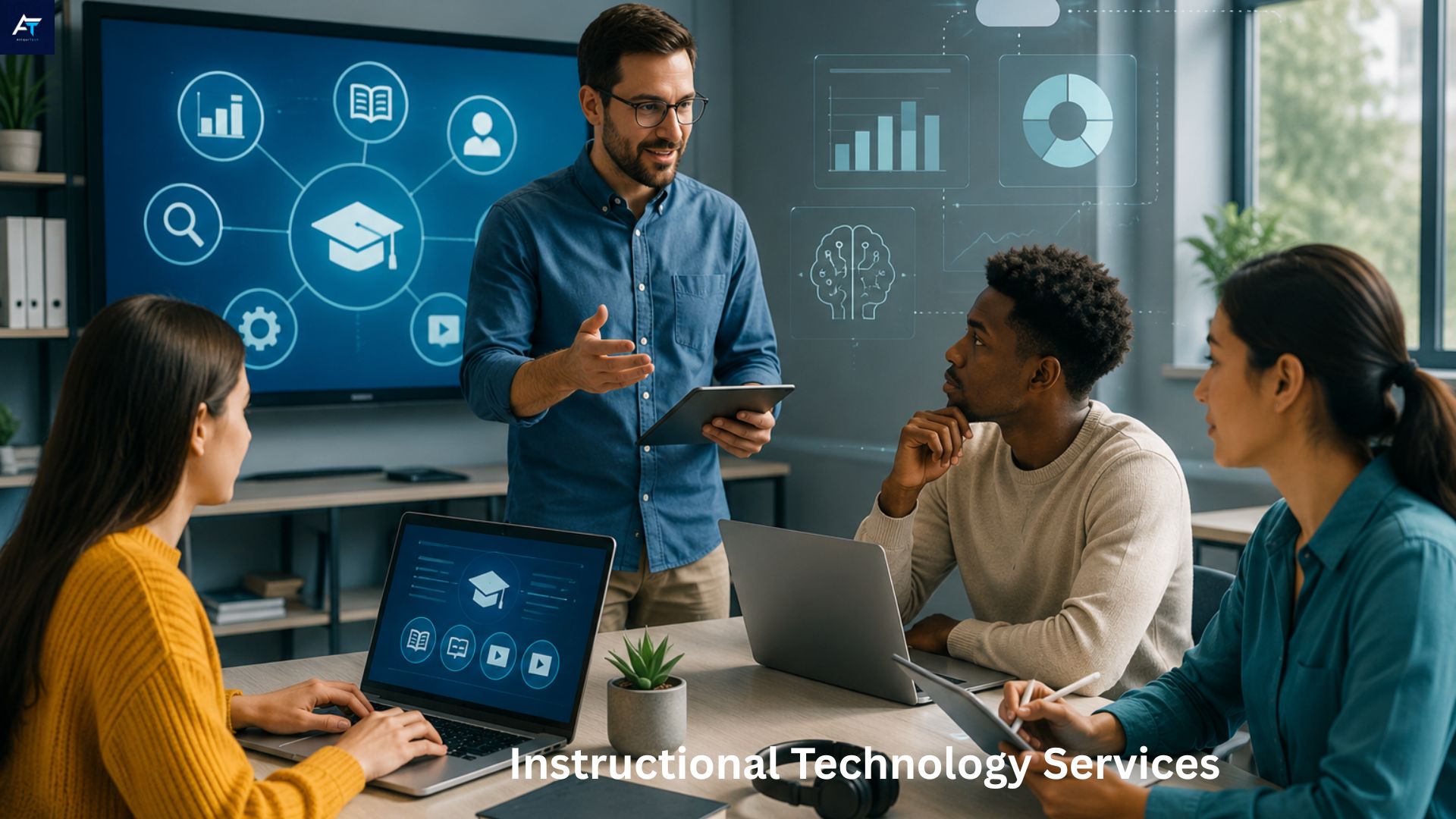
Learn how instructional technology services improve teaching and training with LMS support, eLearning design, AI tools, analytics, and technology integration.
Technology has changed how people teach, learn, train, collaborate, and develop new skills. However, simply introducing new software into a classroom or training program does not automatically improve learning.
That is where instructional technology services become important.
Instructional technology services bring together learning strategies, digital tools, instructional design, learning management systems, content development, analytics, and technical support to create better learning experiences.
Instructional technology can involve both hardware and software as well as the design, implementation, management, integration, and evaluation of technology used for instruction.
Schools, universities, training companies, nonprofit organizations, and businesses can use these services to make learning more accessible, organized, interactive, measurable, and scalable.
This guide explains what instructional technology services are, how they work, their major benefits, the technologies involved, and what organizations should consider before implementing them.
What Are Instructional Technology Services?
Instructional technology services are professional services that help organizations select, design, implement, manage, and evaluate technologies used for teaching and learning.
Success is not about simply adding more technology. Instead, the goal is to use the right technology for a specific learning objective.
Instructional technology combines areas such as:
- Instructional design
- Learning management systems
- eLearning development
- Multimedia learning
- Virtual classrooms
- Assessments
- Learning analytics
- AI-powered learning
- Accessibility
- Technology integration
- Technical support
- Instructor training
Modern instructional technology involves both the technology itself and the strategies used to make it valuable for learners.
Instructional technology has become especially important for online and blended learning because these environments depend heavily on digital platforms and effective technology integration.
Why Are Instructional Technology Services Important?
Having access to technology does not guarantee effective learning.
An organization might purchase an advanced learning platform but struggle with low engagement, confusing course structures, poor accessibility, weak assessments, or inadequate instructor training.
Instructional technology services help connect technology with actual learning objectives.
Improve the Learning Experience
Digital tools can provide learners with videos, simulations, interactive activities, quizzes, discussions, collaborative exercises, and personalized learning paths.
The technology becomes more useful when these elements are intentionally designed around what learners need to understand or accomplish.
Support Online and Blended Learning
Instructional technology provides the infrastructure needed to deliver courses beyond a traditional classroom.
Learning management systems, virtual classroom software, digital assessments, multimedia resources, and communication platforms allow organizations to combine:
- Face-to-face instruction
- Live virtual teaching
- Self-paced eLearning
- Mobile learning
- Collaborative activities
Increase Accessibility
Digital learning can give people access to learning materials regardless of location and can support different learning needs through accessible content and assistive technologies.
Accessibility should therefore be considered during course design rather than added after a course has already been created.
Make Learning Measurable
Many digital learning platforms can track activities such as course participation, assessment results, progress, completion, and learner engagement.
These insights help instructors and organizations understand what is working and where learners may need additional support.
Core Instructional Technology Services
Instructional technology is much broader than installing classroom computers or purchasing educational software.
Here are some of the most important services organizations may use.
1. Instructional Design Services
Instructional design focuses on creating structured learning experiences around specific outcomes.
Instructional designers normally begin by asking questions such as:
- Who are the learners?
- What should they know or be able to do?
- What knowledge or skill gaps exist?
- How should the information be presented?
- Which activities will support learning?
- How should progress be measured?
Instructional design follows a systematic process of analyzing, designing, developing, implementing, and evaluating learning experiences.
The resulting program may combine videos, written materials, quizzes, interactive exercises, practical assignments, live sessions, or other learning activities.
2. Learning Management System Implementation
A Learning Management System or LMS provides a central environment for delivering and managing learning.
An LMS may be used to:
- Organize courses
- Publish lessons
- Enroll learners
- Manage assignments
- Deliver quizzes
- Track progress
- Record completion
- Facilitate discussions
- Generate reports
- Manage certifications
Platforms such as Moodle, Canvas, and Blackboard are examples frequently associated with digital learning environments.
Instructional technology services can help organizations choose an appropriate LMS, configure it, organize course structures, integrate other applications, migrate content, and train users.
3. LMS Support and Optimization
Implementing an LMS is only the beginning.
Organizations may also require ongoing support for:
- Course setup
- User management
- Permissions
- Integrations
- Troubleshooting
- Learning analytics
- Content organization
- Instructor training
- Accessibility
- Platform updates
Good LMS support focuses on making the system easier for instructors, administrators, and learners to use.
4. eLearning Content Development
eLearning development transforms traditional training materials into digital learning experiences.
Instead of simply uploading PDFs or presentation slides, an eLearning course can include:
- Interactive lessons
- Short instructional videos
- Scenario-based exercises
- Knowledge checks
- Digital assessments
- Demonstrations
- Simulations
- Microlearning modules
- Downloadable resources
The format should depend on the audience, subject, learning objectives, available technology, and expected outcome.
5. Multimedia Learning Development
Some concepts become easier to understand when learners can see or interact with them.
Instructional technology teams may therefore help develop:
- Educational videos
- Screen recordings
- Animations
- Interactive presentations
- Audio lessons
- Demonstrations
- Digital whiteboard activities
- Visual learning resources
Presentation software, video, multimedia content, and interactive whiteboards are all common forms of instructional technology.
6. Virtual and Blended Learning Solutions
Not every learning experience needs to take place completely online.
Blended learning combines digital activities with instructor-led or face-to-face learning.
For example, learners might:
- Watch a video before class.
- Complete a short online assessment.
- Attend an instructor-led session.
- Participate in a practical activity.
- Submit an assignment through an LMS.
Instructional technology professionals can determine which activities are best completed online and which benefit from direct instructor interaction.
7. Learning Analytics and Reporting
Learning platforms can generate valuable information about learner behavior and performance.
Analytics may help organizations understand:
- Course completion
- Assessment performance
- Learner participation
- Content engagement
- Learning progress
- Skills gaps
- Areas where learners struggle
Modern LMS environments commonly include analytics and reporting capabilities that instructors can use to monitor learning activity.
Analytics should aim to improve learning, not just collect more data.
8. AI-Powered Learning Technology
Artificial intelligence is becoming increasingly connected with instructional technology.
AI-supported learning systems may assist with tasks such as:
- Creating draft learning content
- Generating practice questions
- Providing personalized feedback
- Supporting learners through AI assistants
- Recommending learning resources
- Creating adaptive learning experiences
- Identifying learning patterns
- Supporting course development
Current instructional technology discussions increasingly include AI-assisted authoring, adaptive learning, learning analytics, and AI-supported learner experiences.
However, AI should support instructional goals rather than become the goal itself.
Human review remains important for accuracy, learning quality, accessibility, and responsible implementation.
9. Accessibility and Inclusive Learning
An instructional technology strategy should consider whether learners with different abilities can access and use the learning environment.
Accessibility considerations may include:
- Keyboard navigation
- Captions for videos
- Transcripts
- Alternative text for images
- Readable typography
- Logical heading structures
- Adequate contrast
- Screen-reader compatibility
- Accessible assessments
Inclusive design can make digital learning easier to use for a much wider audience.
10. Instructor and Staff Technology Training
Even an excellent learning platform may fail if people do not know how to use it.
Technology adoption therefore requires training and support.
Instructional technology support may include:
- Instructor onboarding
- One-to-one assistance
- Workshops
- User documentation
- Video tutorials
- Technology guides
- Help desk support
- Best-practice recommendations
Institutions offering learning technology services commonly combine platform support with staff training, technical assistance, instructional materials, and evaluation of emerging tools.
How Does the Instructional Technology Process Work?
A successful implementation normally starts with learning needs rather than software.
Step 1: Identify the Learning Need
First, determine what problem needs solving.
For example:
- Employees need faster onboarding.
- Students need more flexible course access.
- Instructors need easier assessment tools.
- A company needs scalable compliance training.
- Learners need more interactive practice.
Step 2: Define Learning Objectives
Clearly define what learners should know or be able to do after completing the program.
Technology decisions become much easier when the desired outcome is clear.
Step 3: Evaluate Available Technology
Compare potential tools according to factors such as:
- Learning objectives
- Ease of use
- Accessibility
- Compatibility
- Integration
- Scalability
- Security
- Support
- Cost
Technology evaluation before LMS integration is an important part of effective instructional technology planning.
Step 4: Design the Learning Experience
Next, determine how learners will move through the program.
This may involve lessons, videos, assessments, discussions, assignments, simulations, practical activities, or collaborative work.
Step 5: Develop and Integrate the Technology
The required course content, learning tools, LMS components, and integrations can then be configured or developed.
Step 6: Train Instructors and Learners
Users should understand how to access the system and how each tool contributes to the learning process.
Step 7: Measure and Improve
After launch, monitor learner feedback, participation, assessment performance, technical issues, and other useful indicators.
The program can then be refined based on actual learner needs.
Benefits of Instructional Technology Services
When implemented strategically, instructional technology can provide several advantages.
Better Learner Engagement
Interactive activities, multimedia, discussions, simulations, and immediate feedback give learners more ways to participate.
Flexible Learning
Online platforms allow learners to access educational resources across different locations and schedules.
Consistent Training
Organizations can create standardized learning programs and deliver the same core material across teams or locations.
Scalable Learning
Digital courses can make it easier to deliver training to growing groups without recreating the entire program for every learner.
Personalized Experiences
Learning platforms can support different pathways, resources, assessments, and activities according to learner needs.
Better Performance Insights
Learning analytics give instructors and training teams additional information to identify gaps and improve their programs.
Easier Collaboration
Discussion areas, peer review, messaging, group projects, and virtual classrooms can support communication between learners and instructors.
Instructional Technology vs Educational Technology
The terms instructional technology and educational technology are often used interchangeably, but a useful distinction exists.
Educational technology is a broad term covering technologies, systems, and digital tools used throughout education.
Instructional technology focuses more specifically on how technologies are selected, designed, integrated, and evaluated to improve teaching and learning.
In simple terms:
Educational technology = the wider technology ecosystem
Instructional technology = applying technology effectively to instruction.
Teachfloor similarly distinguishes educational technology as the tools or products and instructional technology as the practice of applying those tools to create effective learning experiences.
Who Uses Instructional Technology Services?
Instructional technology is useful across many learning environments.
Schools
Schools can use learning platforms, classroom technology, multimedia resources, digital assessments, and teacher training.
Colleges and Universities
Higher education institutions often depend on LMS platforms, virtual classrooms, lecture technologies, multimedia content, accessibility tools, and faculty technology support.
Businesses
Companies can use instructional technology for:
- Employee onboarding
- Compliance training
- Product training
- Leadership development
- Sales training
- Technical skills
- Professional development
Healthcare Organizations
Digital learning and simulation can support clinical education, procedural training, compliance, and continuing professional development.
Government and Nonprofit Organizations
Organizations with distributed teams can use digital learning systems to standardize training while giving staff flexible access to educational resources.
Training Providers
Professional trainers can use instructional technology to deliver courses to larger audiences through online or blended learning models.
How to Choose Instructional Technology Solutions
The most advanced software is not always the best solution.
Before adopting a technology, consider the following questions.
Does It Solve a Real Learning Problem?
Start with the learning objective instead of choosing software because it is popular.
Is It Easy to Use?
Complex systems can create barriers for both instructors and learners.
Does It Integrate With Existing Systems?
Check whether the platform works with your LMS, authentication system, video tools, analytics environment, and other technologies.
Is It Accessible?
Accessibility should be evaluated before implementation.
Can It Scale?
Consider how the technology will perform as courses, users, and learning programs increase.
What Support Is Available?
Training, documentation, technical assistance, and ongoing platform support can significantly affect successful adoption.
Can Results Be Measured?
Choose tools that provide meaningful information connected with your learning objectives.
Common Instructional Technology Mistakes
Organizations can reduce unnecessary complexity by avoiding several common mistakes.
Selecting Tools Before Defining Goals
Technology should support the learning strategy, not determine it.
Using Too Many Platforms
Adding more tools can increase complexity for learners and instructors.
Choose technology only when it serves a clear purpose.
Ignoring User Experience
A course may contain excellent information but still perform poorly if learners cannot navigate it easily.
Neglecting Instructor Training
Teachers and trainers need enough time and support to become comfortable with new systems.
Ignoring Accessibility
Accessibility should be part of the original design process.
Focusing Only on Completion Rates
Finishing a course does not necessarily mean that meaningful learning occurred.
Assessments, practical application, learner feedback, and performance indicators can provide additional insight.
Failing to Review the Program
Learning technology should continue evolving as learner needs, content, and available tools change.
The Future of Instructional Technology
Instructional technology continues to evolve as artificial intelligence, analytics, immersive technologies, and adaptive learning systems become more capable.
Several areas are becoming increasingly relevant:
- AI-assisted course development
- Personalized learning
- Adaptive assessments
- Learning analytics
- Conversational learning assistants
- Mobile-first learning
- Microlearning
- Simulation-based learning
- Virtual and augmented reality
- Automated feedback
- Collaborative learning platforms
The future is unlikely to be about replacing instructors with technology.
Instead, the strongest opportunities come from combining human teaching expertise with technologies that make learning more accessible, flexible, interactive, and measurable.
Best Practices for Successful Instructional Technology
A strong instructional technology strategy should:
- Begin with learner needs.
- Define measurable learning objectives.
- Choose technology only after defining those objectives.
- Keep the learner experience simple.
- Build accessibility into the design.
- Provide adequate instructor training.
- Use meaningful assessments.
- Monitor learning data.
- Collect learner feedback.
- Continuously improve courses and technology.
The question should never be:
“What technology can we use?”
A better question is:
“What learning problem are we trying to solve, and which technology can help us solve it effectively?”
What is an example of instructional technology?
Examples include learning management systems, online assessments, interactive whiteboards, virtual classroom platforms, educational videos, simulations, authoring tools, learning analytics platforms, and AI-supported learning applications.
What does an instructional technologist do?
An instructional technologist helps evaluate learning needs, select appropriate technologies, configure learning systems, support instructors, develop digital learning experiences, integrate tools, and evaluate their effectiveness.
What is the difference between instructional design and instructional technology?
Instructional design focuses primarily on designing effective learning experiences. Instructional technology has a broader technology component that includes selecting, implementing, integrating, supporting, and evaluating the tools used to deliver those experiences.
Final Thoughts
Instructional technology services connect technology with effective teaching and learning.
The real value does not come from having more software, devices, or AI tools. It comes from selecting the right technologies, designing them around learner needs, integrating them correctly, supporting the people who use them, and continuously evaluating whether they are producing meaningful results.
From instructional design and LMS implementation to eLearning development, analytics, accessibility, virtual learning, and AI-supported education, instructional technology can help schools, universities, businesses, and training organizations create learning experiences that are more flexible, engaging, scalable, and measurable.
As learning technology continues to evolve, organizations that focus first on learning outcomes and user needs will be better positioned to benefit from new tools without allowing technology to become an unnecessary distraction.
For more information: Click Here