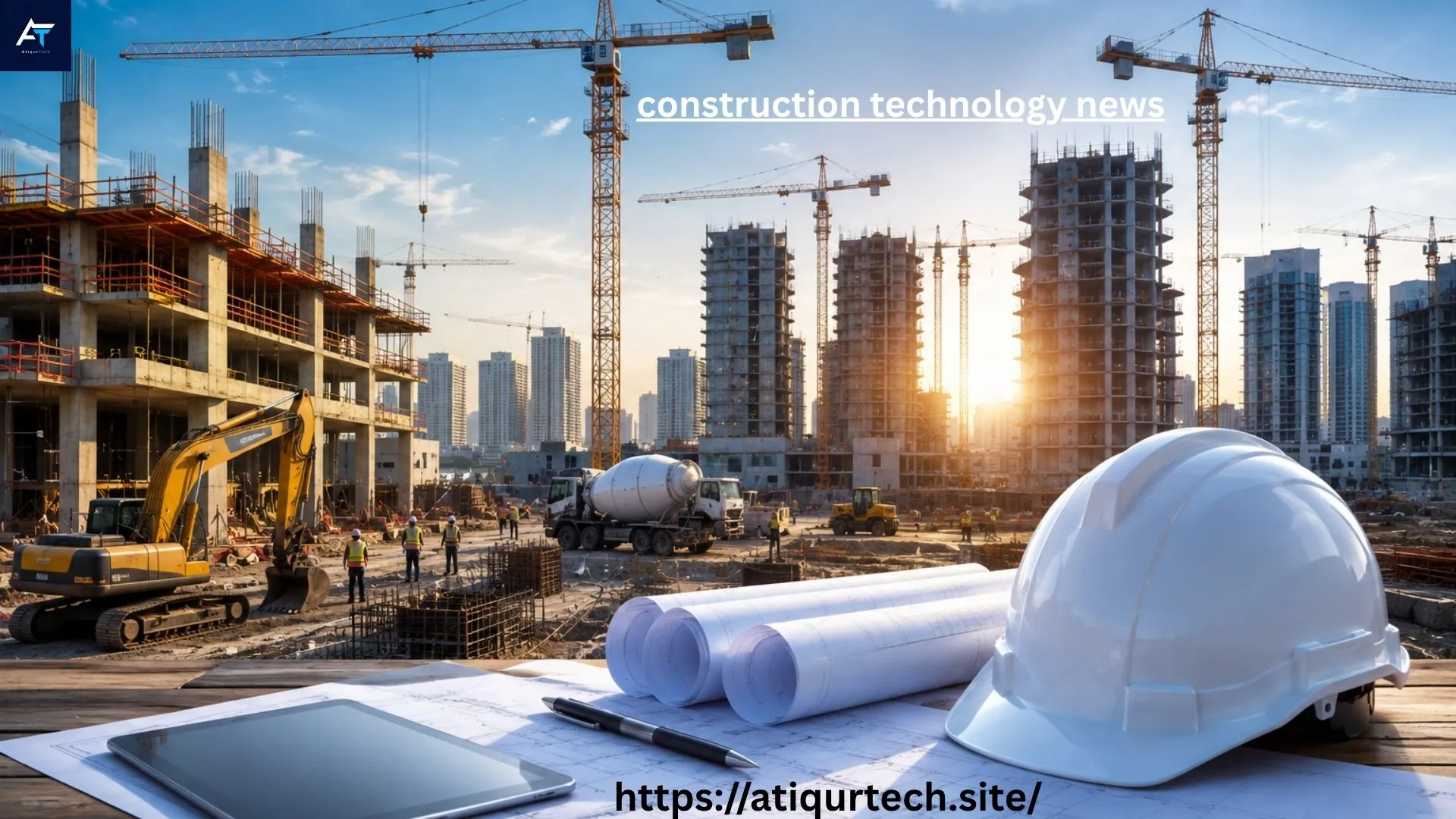
Follow the latest construction technology news for 2026, including AI, BIM, digital twins, drones, robotics, 3D printing, and smart jobsite technology.
Construction technology news in 2026 is increasingly focused on one major question: how can digital tools help construction teams design, plan, and build more accurately while dealing with complex projects, workforce pressures, safety risks, and fragmented project information?
Artificial intelligence, Building Information Modeling (BIM), digital twins, drones, robotics, reality capture, construction management platforms, and automated equipment are moving deeper into everyday construction workflows. Current industry research also suggests that contractors are particularly interested in AI, precise surveying and positioning, better data integration, and improved interoperability between their existing technology platforms.
Technology, however, is not transforming construction simply by introducing more software. The bigger change involves connecting information from design offices, project managers, contractors, equipment, and workers on the jobsite.
This construction technology news guide looks at the most important developments shaping the industry in 2026, what they mean for construction professionals, and which technologies could have the greatest long-term impact.
What Is Construction Technology?
Construction technology news, often shortened to ConTech, refers to digital systems, equipment, software, and engineering technologies used to improve the planning, design, construction, and management of buildings and infrastructure.
Modern construction technology news can include:
- Artificial intelligence and machine learning
- BIM software
- Digital twins
- Construction management platforms
- Drones
- Robotics
- Autonomous machinery
- LiDAR and laser scanning
- IoT sensors
- Computer vision
- Augmented and virtual reality
- 3D printing
- Wearable safety technology
- Cloud collaboration platforms
- Prefabrication and modular construction technology
Older construction technologies often worked independently. A surveying system might collect one set of information, BIM software another, and project-management software another.
Construction technology news is increasingly focused on connecting those systems.
Trimble’s 2026 contractor research, for example, identifies technology integration and eliminating isolated data silos as major priorities for construction businesses.
That shift from isolated tools toward connected construction ecosystems is one of the biggest stories to watch.
Latest Construction Technology News and Trends in 2026
Construction technology news is developing across multiple areas rather than around one breakthrough invention.
Some of the most important trends currently include:
- AI-assisted construction management
- Agentic AI development
- Advanced BIM workflows
- Digital twins
- Reality capture
- Laser scanning
- Drone surveying
- Construction robotics
- Autonomous equipment
- Computer vision
- Connected construction software
- 3D printing
- Prefabrication
- Smart safety technology
- Data interoperability
Construction technology news research from Trimble indicates that AI, scanning, surveying, positioning, data sharing, and analytics are among contractors’ technology priorities for 2026.
This construction technology news is also becoming increasingly interconnected.
For example, a drone may capture site information while AI analyzes the images and compares them with a BIM model. That data can then update project-management systems or contribute to a digital representation of the site.
This connected approach is becoming an important part of construction’s digital transformation.
AI and Machine Learning Are Moving Into Construction Workflows
Artificial intelligence is one of the most closely watched areas in construction technology news.
Construction companies generate enormous quantities of information through drawings, contracts, schedules, photographs, BIM models, equipment, inspections, and project-management systems.
AI gives companies new ways to analyze that information.
Predictive Construction Analytics
Machine-learning systems can examine historical and current project information to help teams recognize patterns and potential risks.
Applications may include:
- schedule-risk identification
- cost analysis
- resource planning
- document classification
- project forecasting
- quality-control support
- change-order analysis
- equipment monitoring
Rather than relying only on manually prepared reports, project teams can increasingly use analytics to identify issues earlier.
Autodesk identifies AI and machine learning as significant technologies for improving construction workflows, decision-making, and predictive analysis.
Computer Vision on Construction Sites
Computer vision enables software to analyze, understand, and extract meaningful information from images and videos.
- progress documentation
- PPE monitoring
- hazard identification
- quality inspections
- site security
- comparing completed work with project models
AI-enabled tools can also compare captured site information with digital models to identify differences between planned and actual conditions.
The result could be faster visibility into jobsite conditions without requiring managers to review every photograph or inspection record manually.
Agentic AI Could Be the Next Stage
Another emerging topic is agentic AI.
Traditional AI tools generally respond to individual requests. Agentic systems are being developed to perform sequences of tasks across different systems with less manual intervention.
Trimble expects agentic AI experiments to move further into real construction workflows, including areas such as schedules, design processes, progress tracking, resource management and conflict resolution.
Construction technology news is still evolving, so human supervision, data quality, accountability, and safety will remain important.
BIM, Digital Twins and Reality Capture Become More Connected
Building Information Modeling has already changed how architects, engineers and contractors coordinate construction information.
The next stage involves connecting BIM with real-world project data.
BIM Is Becoming More Data Driven
A BIM model can contain far more than a three-dimensional representation of a building.
Depending on how it is implemented, it can help teams coordinate:
- architectural information
- structural systems
- mechanical systems
- electrical systems
- plumbing systems
- quantities
- construction sequencing
- design revisions
- asset information
Cloud-connected BIM also allows geographically distributed project teams to work with more consistent information.
The long-term trend is moving BIM from an isolated design tool toward a central source of project intelligence.
Digital Twins Extend the Model
A digital twin is a digital representation connected with information about a real physical asset or environment.
Where BIM commonly supports design and construction information, digital twins can continue receiving data after the asset exists.
Information may come from:
- IoT sensors
- equipment
- building systems
- laser scanners
- drones
- cameras
- operational databases
Digital twins can therefore support monitoring, analysis, and decision-making across more of an asset’s lifecycle.
Autodesk’s 2026 industry discussion highlights the growing relationship among AI, reality capture, and digital twins, emphasizing practical applications rather than technology for its own sake.
Reality Capture Is Becoming More Accessible
Reality capture creates digital information about physical environments through technologies such as:
- laser scanners
- LiDAR
- photogrammetry
- drones
- 360-degree cameras
- mobile scanning devices
Project teams can use these technologies to document existing conditions or monitor construction progress.
Autodesk reports that reality-capture technology once associated primarily with major projects is becoming practical for a wider range of construction companies and project sizes.
That accessibility could make reality capture an increasingly normal part of construction documentation.
Drones, Robotics and Autonomous Equipment Expand on Jobsites
Construction sites contain repetitive, physically demanding, and sometimes hazardous activities. This makes them an obvious testing ground for automation.
Construction Drones
Drones can capture aerial images and site information without requiring surveyors or inspectors to access every location physically.
Common applications include:
- site surveying
- progress photography
- mapping
- stockpile measurements
- roof inspections
- infrastructure inspections
- site monitoring
Drone information can also be combined with photogrammetry or 3D modeling systems.
The technology is particularly useful when teams need repeatable visual records of large or difficult-to-access locations.
Construction Robotics
Robotic systems are being developed or deployed for tasks including:
- layout
- drilling
- bricklaying
- material handling
- inspection
- welding
- repetitive finishing tasks
Construction environments are much less predictable than factories, however.
Buildings change continuously while they are being constructed. Workers, equipment and materials also move around the site.
Because of this, human supervision will remain important as robotics becomes more capable.
Autonomous Heavy Equipment
Excavators, bulldozers and other construction machines are gradually gaining greater levels of automation.
Technologies may assist with:
- grading
- excavation
- repetitive earthmoving
- machine positioning
- equipment guidance
- collision avoidance
Rather than eliminating operators immediately, many systems are likely to automate specific parts of their work.
The combination of automated machinery, precise positioning and real-time site data is particularly important for large civil and infrastructure projects.
Construction Software Is Shifting Toward Connected Data
Construction businesses have adopted numerous digital platforms over the past decade.
The next problem is making those systems communicate.
Project teams may use separate platforms for:
- accounting
- estimating
- scheduling
- BIM
- document management
- workforce management
- procurement
- field reporting
- safety
- equipment management
If those platforms cannot exchange information, employees still have to transfer data manually.
That can create duplicate information and inconsistent records.
Trimble’s 2026 contractor research specifically highlights fragmentation and technology integration as continuing construction-industry challenges.
Common Data Environments
A Common Data Environment, or CDE, creates a structured location for project information.
It can help ensure that contractors, engineers, designers and owners work from the appropriate documents and project data.
Increasingly connected cloud systems could make information easier to move throughout the entire construction lifecycle.
That means the future of construction software may depend as much on interoperability as individual software features.
3D Printing, Prefabrication and Modular Construction Continue to Develop
Not every construction technology revolution happens on a computer screen.
Digital manufacturing is also changing how physical building components can be produced.
3D Printing in Construction
Large-scale additive manufacturing systems can build certain components by depositing material layer by layer.
Possible applications include:
- concrete walls
- structural components
- architectural features
- formwork
- customized building elements
3D printing may provide advantages when designs require unusual geometries or repetitive components.
Autodesk continues to identify 3D printing as a technology influencing the development of modern construction.
It is unlikely to replace traditional construction across every project, but specialized applications continue to develop.
Prefabrication and Modular Construction
Prefabrication shifts more construction activity from the jobsite into controlled manufacturing environments.
Components or modules can be produced separately, then transported and assembled on site.
Digital design, BIM, robotics, and automated manufacturing can make this process more precise.
Potential advantages include:
- predictable production
- improved quality control
- reduced onsite activity
- more efficient material use
- repeatable construction processes
Technology is therefore helping blur the traditional boundary between construction and manufacturing.
Smart Construction Technology Is Changing Jobsite Safety
Safety is another important area for construction innovation.
Technology does not replace proper training, supervision, or safety procedures, but it can provide additional information.
Wearable Technology
Connected wearables can potentially monitor factors such as:
- worker location
- environmental exposure
- equipment proximity
- movement
- fatigue-related indicators
The usefulness of these systems depends heavily on appropriate implementation and employee privacy policies.
AI Safety Monitoring
Computer-vision systems can analyze cameras or captured images to identify selected jobsite conditions.
Some AI construction applications can detect PPE compliance, hazard areas, or deviations between actual construction and digital models.
These systems should generally be treated as additional safety tools rather than substitutes for experienced safety professionals.
Smart Equipment
Connected machinery can transmit operational information including:
- equipment location
- usage
- maintenance status
- fuel consumption
- machine performance
Predictive-maintenance systems can then help teams identify potential equipment problems before a major failure occurs.
How Construction Technology Can Improve Project Delivery
The value of construction technology ultimately depends on whether it solves a real problem.
Some of the key potential benefits include:
Better Project Visibility
Digital dashboards, reality capture and connected project systems can make current project information easier to access.
Improved Collaboration
Cloud-based systems allow designers, engineers, contractors and owners to share information without relying entirely on emails or disconnected documents.
Earlier Risk Identification
AI, predictive analytics and progress-monitoring technologies can help project teams notice potential problems earlier.
More Accurate Construction
BIM coordination, laser scanning, machine positioning and digital layout systems can improve precision.
Reduced Repetitive Work
Automation can handle selected administrative, analytical or physical tasks that would otherwise consume employee time.
Improved Safety Information
Sensors, cameras, drones and computer vision can provide additional visibility into potentially dangerous environments.
Better Lifecycle Information
Digital twins and connected asset data can extend the usefulness of construction information into building operations and maintenance.
Technology itself, however, does not automatically create these benefits.
Successful implementation depends on selecting tools that address genuine project needs.
Challenges Facing Construction Technology Adoption
The latest technology can also create new problems.
Construction businesses should consider several issues before investing.
Integration
New software needs to work with existing business systems.
Adding another disconnected application can make information management harder, not easier.
Data Quality
AI and analytics cannot compensate indefinitely for incomplete or inaccurate construction data.
Companies need consistent data-management processes.
Cybersecurity
As construction systems become connected through cloud platforms, equipment and IoT devices, cybersecurity becomes increasingly important.
Access controls, secure authentication, backups and employee training should be part of a company’s technology strategy.
Training
A powerful platform has little value when employees do not understand how or why to use it.
Technology adoption needs to include training and workflow development.
Cost
Not every emerging technology produces a sufficient return for every contractor.
Companies should identify a specific business or project problem before selecting the technology.
Human Oversight
Construction involves safety-critical decisions and unpredictable real-world environments.
Even as AI becomes more autonomous, human judgment and clearly defined accountability remain essential concerns. Trimble’s discussion of construction AI similarly emphasizes the importance of determining when human involvement is necessary as autonomous capabilities increase.
What Construction Companies Should Watch Next
Several areas deserve particular attention as construction technology continues to develop.
Connected AI Systems
AI is likely to become integrated directly into construction software rather than operating only through standalone applications.
AI Agents
Agentic AI could automate multi-step workflows involving documents, schedules, models, and project information.
Real-Time Digital Twins
Improved sensors and reality capture could make digital twins more representative of current site conditions.
Autonomous Equipment
Machines may gain greater autonomy for repetitive and controlled jobsite tasks.
Better Interoperability
The construction industry will continue looking for ways to move information between different software ecosystems.
More Accessible Reality Capture
Scanning and visual documentation tools are becoming easier for smaller teams to adopt.
AI-Powered Construction Safety
Computer vision and predictive systems could provide project managers with additional safety intelligence.
Construction Data Analytics
Companies with years of project information may increasingly use AI to identify patterns that were previously difficult to detect.
The Future of Construction Technology
The future of construction is unlikely to be defined by a single robot, software platform, or AI model.
The more significant transformation is creating connected construction environments.
A project might eventually connect:
BIM → scheduling → estimating → equipment → workers → drones → reality capture → AI analytics → digital twin → building operations.
Instead of storing important project information in disconnected systems, construction teams could move toward continuous flows of digital information.
Current industry research already points strongly toward integration, AI, precision technology, and improved data workflows as priorities.
That does not mean every construction company should chase every new trend.
The most effective technology strategy starts with a problem.
If a drone makes inspections safer, use it.
If BIM reduces coordination conflicts, use it.
If AI helps a manager identify project risk earlier, use it.
If an expensive technology provides no meaningful improvement to the project, there may be little reason to adopt it.
The most successful construction companies will therefore not necessarily be those using the most technologies. They will be the ones that connect the right tools with experienced people, reliable information, and well-designed construction processes.
What is construction technology?
Construction technology includes software, digital systems, equipment, and engineering methods used to improve how buildings and infrastructure are designed, planned, built, monitored, and maintained.
What is the latest technology used in construction?
Important current technologies include artificial intelligence, BIM, digital twins, drones, robotics, autonomous equipment, reality capture, LiDAR, IoT sensors, cloud construction platforms, computer vision, and 3D printing.
What are the biggest construction technology trends in 2026?
AI, precise surveying and positioning, scanning, better data integration, analytics, BIM, digital twins, and increasing automation are among the significant trends being discussed across the construction sector in 2026.
How is AI being used in construction?
AI can assist with document analysis, predictive analytics, scheduling, risk identification, BIM compliance checks, progress monitoring, computer vision, safety monitoring, and project data analysis.
How are drones used in construction?
Construction drones can support aerial surveying, site mapping, progress documentation, inspections, photography, and other forms of reality capture.
Conclusion
Construction technology news increasingly focuses on the convergence of physical construction and digital intelligence.
AI is analyzing construction data. BIM is becoming more connected. Digital twins are linking physical assets with digital information. Drones and scanners are capturing jobsites. Robots and automated machinery are taking on selected physical tasks. Cloud platforms are connecting office and field teams.
At the same time, construction companies are discovering that purchasing more technology is not enough.
The real competitive advantage comes from choosing technology that solves real construction problems, connects information across systems, and helps experienced professionals make better decisions.
As AI, automation, reality capture, BIM, and connected construction platforms continue to evolve, AtiqurTech will follow key developments and explain what new construction technologies mean for contractors, engineers, architects, project managers, and the wider AEC industry.