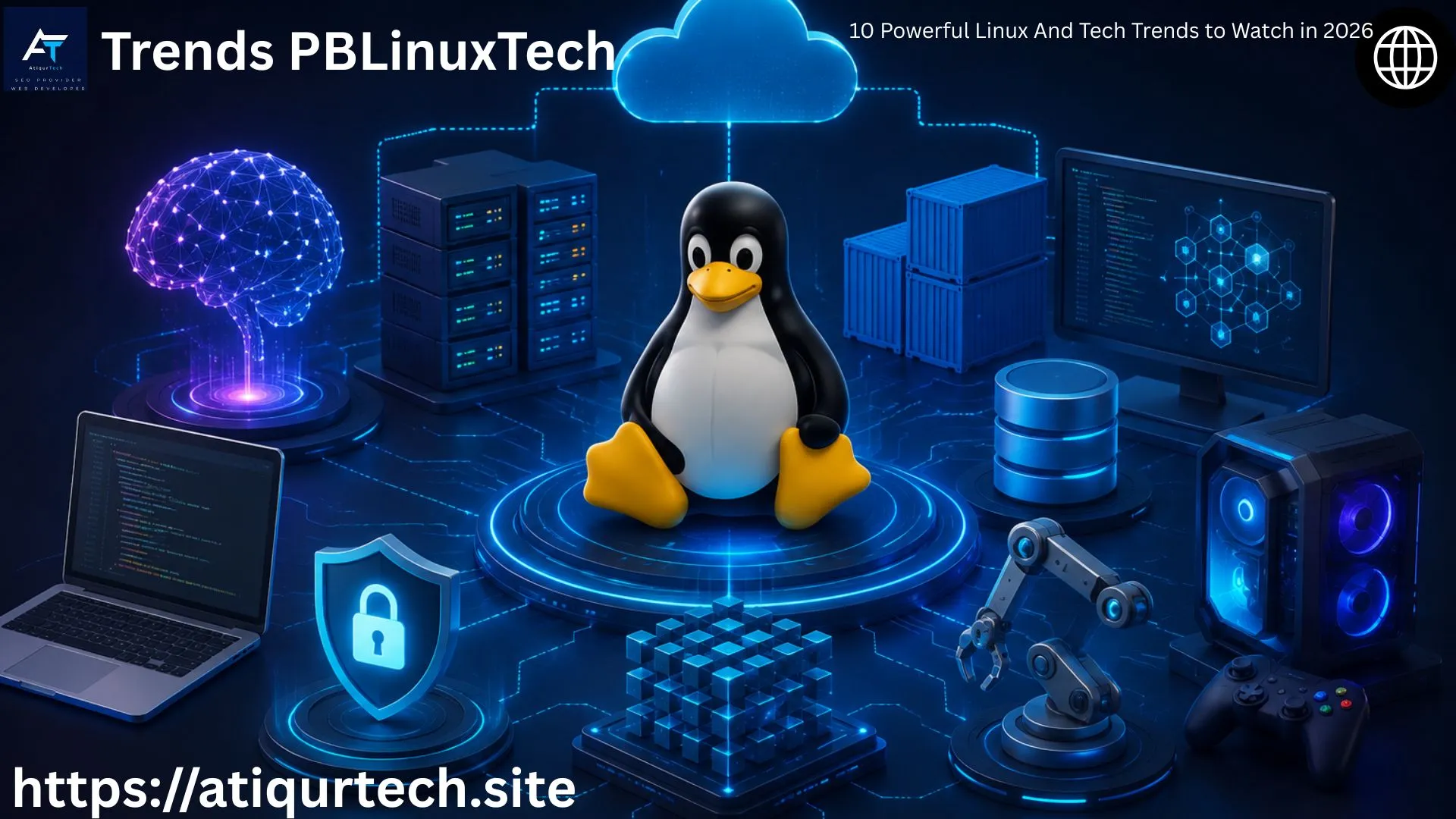
Discover Trends PBLinuxTech with 10 powerful Linux and tech trends shaping 2026, from AI innovations to open-source breakthroughs and future technologies.
Technology is changing fast. AI is becoming part of everyday software, cloud computing is growing, cybersecurity is more important than ever, and more developers and businesses are using open-source tools.
Linux plays a major role in many of these changes.
This is why Trends PBLinuxTech is often connected with Linux, artificial intelligence, cloud computing, cybersecurity, automation, gaming, and other new technologies.
But Trends PBLinuxTech is not one single product or technology. It is better understood as a broad term encompassing many interconnected areas of modern technology.
In this guide, we will look at the most important Trends PBLinuxTech trends to watch in 2026 and explain them in simple words.
What Is Trends PBLinuxTech?
Trends PBLinuxTech is a term used to refer to discussions about Linux, open-source software, AI, cloud technology, cybersecurity, automation, gaming, and other growing areas of technology.
There is no single official definition of PBLinuxTech.
Instead, you can think of it as a group of related technology trends, including:
- Linux and open-source operating systems
- Artificial intelligence
- Cloud computing
- Containers
- Kubernetes
- Cybersecurity
- DevOps
- Automation
- Edge computing
- Internet of Things
- Linux gaming
- Open-source software
- Performance improvement
These technologies are also becoming increasingly connected.
For example, a developer may use Linux for development, Docker to package an application, Kubernetes to manage it, and a cloud platform to run it.
That is a good example of how modern PBLinuxTech trends work together.
1. Linux Is Becoming More Important: Trends pblinuxtech
Linux has been used on servers for many years. Today, its role is much bigger.
Linux is now widely used in areas such as:
- Cloud platforms
- Web servers
- Software development
- AI systems
- Containers
- Cybersecurity
- Networking
- Embedded devices
- Edge computing
- Gaming
One of the biggest advantages of Linux is flexibility.
A user can choose a Linux distribution based on their needs. Some distributions work well on old or low-powered computers, while others are designed for developers, servers, cloud systems, or security work.
Linux is also open source. This means developers can study the code, change it, customize it, and build their own solutions.
For this reason, Linux is not just a technology trend. It is also the base for many other modern technologies.
2. AI and Linux Are Growing Together
Artificial intelligence is one of the biggest technology trends in 2026.
Linux has an important role in AI development because developers often need greater control over software, computing resources, GPUs, containers, and server environments.
Several AI-related trends are becoming especially important.
Open-Source AI
More developers now have access to open-source AI models, libraries, frameworks, and tools.
This makes AI easier to explore for:
- Developers
- Students
- Startups
- Researchers
- Universities
- Independent creators
- Businesses
Open-source AI also gives developers more freedom to change and customize their projects.
Local AI
Another growing trend is local AI.
Instead of sending every request to an online server, some AI models can run directly on a computer or device.
This may give users more control over:
- Privacy
- Personal data
- Speed
- Customization
- Offline use
Linux users are well positioned to test local AI because many AI development tools already work well on Linux.
AI-Assisted Coding
AI is also changing the way programmers work.
Developers can use AI tools to help with:
- Finding coding errors
- Explaining code
- Creating tests
- Writing documentation
- Reviewing code
- Building early prototypes
- Debugging problems
This does not mean AI will replace every developer.
A more realistic trend is that AI is becoming another useful tool in a developer’s daily workflow.
3. Cloud-Native Technology Keeps Growing
Cloud-native computing is another major part of PBLinuxTech trends.
Older applications were often built as one large system and installed on a single server.
Modern applications can work differently. Trends in PBLinuxTech are significant.
Developers can divide them into smaller parts and run those parts across flexible cloud systems.
Several technologies make this possible.
Containers
Containers package an application together with the files and components it needs to run.
This makes it easier to move software between development, testing, and live environments.
Docker helped make containers popular among developers.
Kubernetes
Managing a few containers may be simple.
Managing hundreds or thousands of them is much harder.
Kubernetes helps automate the deployment, scaling, and management of container-based applications.
It is widely connected with modern cloud systems and is also becoming important in AI infrastructure.
Microservices
Microservices allow developers to break a large application into smaller services.
Each service can handle a specific job.
This can make an application more flexible, but it can also make the system more complicated to manage.
That is why microservices, containers, Kubernetes, monitoring, and automation are often used together.
4. Automation Is Becoming an Important IT Skill
Modern IT systems can be too large and complex to manage manually.
That is why automation is becoming more important.
Popular automation tools and systems include:
- Ansible
- Terraform
- CI/CD tools
- Git-based deployment tools
- Configuration management platforms
Imagine a company has 50 servers.
An administrator could configure every server manually, but that would take a lot of time and could lead to mistakes.
With automation, the administrator can create a set of instructions and apply the same setup across many systems. Trends pblinuxtech are very significant.
Automation can help improve:
- Speed
- Consistency
- System management
- Documentation
- Repeatability
Because of this, automation is becoming an important skill for developers, system administrators, DevOps engineers, and cloud professionals.
5. Cybersecurity Is Becoming Continuous
Cybersecurity is another major trend in Linux.
Using Linux does not automatically make a computer or server secure.
Security still depends on many things, including:
- Updates
- User permissions
- Network settings
- Software configuration
- Applications
- Access control
- User behavior
Modern cybersecurity is moving toward continuous protection.
Instead of checking security only once, teams are trying to monitor systems continuously.
Better Access Control
Companies are becoming more careful about who can access systems, applications, and data.
A simple rule is useful here:
Give users and applications only the access they actually need.
This can reduce unnecessary security risks.
Faster Vulnerability Management
Old software and packages can create security problems.
Automated updates, security scans, dependency checks, and testing tools can help teams find issues earlier.
Better System Visibility
Security teams also want to understand what applications are doing after they are launched.
They may monitor:
- Running processes
- Network traffic
- System activity
- Application behavior
- Resource usage
This can help teams find both performance problems and unusual activity.
6. Edge Computing Is Growing
Cloud computing usually sends data to large remote servers for processing.
Edge computing works differently.
It moves some processing closer to where the data is created.
Edge computing can be useful in:
- Smart factories
- Security cameras
- Retail systems
- Healthcare devices
- Industrial sensors
- Transportation
- Smart homes
- Telecom equipment
Linux can work well in these environments because it can be customized for many different types of hardware.
Linux and IoT
Internet of Things devices often require small, efficient operating environments.
Linux-based systems can give developers enough flexibility to build software for specific devices.
AI is also becoming part of this trend.
As AI models become smaller, some devices may process information locally instead of sending everything to the cloud.
7. Linux Gaming Continues to Get Better
Gaming is one of the most visible areas where Linux has improved.
In the past, game compatibility was one of the biggest reasons many people avoided desktop Linux.
Today, the situation is much better.
Important technologies include:
- Steam
- SteamOS
- Proton
- Vulkan
- Wine
- Better graphics drivers
Proton and Windows Games
Proton allows many Windows games to run on Linux without developers having to create a separate Linux version.
This has made Linux gaming much easier for normal users.
The Steam Deck Effect
Valve’s Steam Deck also helped introduce more gamers to Linux.
Many Steam Deck owners use a Linux-based gaming system without needing deep Linux knowledge.
Today, Linux gaming discussions are not only about whether a game can run.
Gamers also care about:
- Performance
- Compatibility
- Drivers
- Handheld gaming
- Anti-cheat support
- Gaming-focused Linux distributions
- Optimization
However, compatibility is still not perfect.
Some games, especially games that use certain anti-cheat systems, may still have problems.
It is a good idea to check game compatibility before moving completely from Windows to Linux.
8. Open-Source Software Is Bigger Than Linux
Linux may be one of the most famous open-source projects, but open source goes far beyond Linux.
Developers now use open-source tools for:
- Databases
- Programming languages
- Web development
- AI
- Cloud computing
- Monitoring
- Cybersecurity
- Automation
- Content management systems
Open source is no longer only an alternative to commercial software.
It has become a normal part of modern technology.
Many businesses now use a mix of open-source software, paid software, and cloud services.
They do not always have to choose only one type.
9. Observability Is Becoming More Important
Modern applications can run across many different systems at the same time.
An application may use:
- Containers
- APIs
- Databases
- Cloud servers
- Microservices
- External platforms
When a problem happens, knowing that a server is online is not enough.
Developers need to understand what is happening inside the entire system.
This is where observability becomes useful.
Observability usually includes information about:
- Logs
- Metrics
- Traces
- Errors
- Network activity
- Resource usage
With better observability, developers can answer questions such as:
- Why is the website slow?
- Which service has failed?
- Where is the delay happening?
- Is a server using too much memory or CPU?
- Is unusual activity happening?
As systems become more complex, observability will continue to be important.
10. Lightweight Computing Is Getting Attention Again
Technology does not always mean using bigger software and more powerful computers.
There is also growing interest in efficiency.
Lightweight Linux distributions can help older computers remain useful for tasks such as:
- Web browsing
- Programming
- Office work
- Education
- Media
- Basic servers
Efficient software can also reduce the amount of computing power needed in cloud and edge environments.
This connects several useful ideas:
- Better performance
- Lower cost
- Longer device life
- Better accessibility
- Less wasted computing power
For people with older computers, lightweight Linux can be a practical option.
How Trends in Linux Tech Affect Everyday Users
Many of these topics may sound technical, but they can affect normal users too.
For Students
Learning Linux can help students understand computers more deeply.
It can introduce them to:
- Operating systems
- Networking
- Programming
- Cybersecurity
- Cloud computing
For Developers
Developers can benefit from learning Linux, Git, containers, automation, and cloud technology.
These skills can make development work more flexible.
For Businesses
Businesses can use open-source tools when building websites, applications, servers, and internal systems.
This can give them more choices when planning technology projects.
For Gamers
Better Linux gaming support gives gamers another operating system to consider.
Not every game works perfectly, but support has improved.
For IT Professionals
Linux, cloud computing, automation, containers, and cybersecurity are closely connected.
Learning one of these areas can often help you understand the others.
Linux and Technology Skills Worth Learning in 2026
You do not need to learn every tool at the same time.
Start with the basics and build your skills step by step.
Beginner Skills
Start with:
- Linux basics
- Terminal commands
- Files and folders
- Installing software
- Basic networking
- Git
Spend time practicing these skills before moving on to more advanced tools.
Intermediate Skills
After learning the basics, you can explore:
- Bash scripting
- Docker
- Python
- Databases
- Web servers
- Linux security
- Cloud basics
These skills can help you understand how modern applications are built and managed.
Advanced Skills
Later, you may learn:
- Kubernetes
- Terraform
- Ansible
- CI/CD
- Infrastructure automation
- Observability
- Cloud architecture
- Cybersecurity
- AI infrastructure
You do not need all of them.
Choose your learning path based on the type of work or projects you want to do.
What Could Shape Future LinuxTech Trends?
Several areas are likely to remain important as Linux and open-source technology continue to develop.
These include:
- More AI running on open infrastructure
- Smaller AI models running on local devices
- More cloud-native applications
- Better automation
- Stronger software security
- More container development
- Growth in edge computing
- Better Linux gaming
- More powerful developer tools
- Improved observability
- Continued open-source development
The biggest trend is how these technologies work together.
Linux, AI, cloud computing, automation, security, and open-source software are increasingly interconnected.
Knowing how these technologies connect can be just as useful as understanding each one separately.
Is Trends PBLinuxTech a Product or Technology?
There is no single product or officially defined technology called Trends PBLinuxTech.
Trends PBLinuxTech is better understood as a Search phrase connected with Linux, open-source software, gaming, cloud computing, artificial intelligence, cybersecurity, automation, and other technology trends.
Different websites may explain the phrase in slightly different ways.
Rather than treating PBLinuxTech as a single product, it is more useful to focus on the underlying technologies it relies on.
What does Trends PBLinuxTech mean?
Trends PBLinuxTech is a Search term connected with Linux, open-source software, AI, cloud computing, cybersecurity, automation, gaming, and other technology trends. It is not one officially defined technology.
Is PBLinuxTech related to Linux?
Yes. Much of the content connected with PBLinuxTech focuses on Linux and open-source technology, including cloud systems, development tools, security, servers, and gaming.
What are the biggest Linux trends in 2026?
Important trends include AI, cloud-native computing, Docker, Kubernetes, cybersecurity, automation, edge computing, observability, open-source development, and Linux gaming.
How is AI connected to Linux?
Linux is widely used in development environments where AI applications are created, tested, deployed, and managed. It also works well with many open-source and local AI tools.
Final Thoughts
Trends: PBLinuxTech covers a wide range of technology changes happening around Linux and the open-source world.
Linux remains an important foundation, but the bigger picture now includes AI, Docker, Kubernetes, cloud-native applications, cybersecurity, automation, edge computing, open-source software, and gaming.
If you are new to these topics, you do not need to learn everything at once.
Start with Linux basics.
Learn how files, commands, software, and networking work. After that, try Git, Python, Docker, security, or cloud computing.
Once you understand the basics, you can move into Kubernetes, automation, cybersecurity, AI, or any other area that matches your goals.
The technology world will keep changing, but strong basic skills will make it much easier to understand what comes next.
For More Information: Click Here